
In the dim glow of his monitors, Alex scrolled through yet another forum thread debating the latest GPU prices. It was March 2026, and the same question echoed across every hardware community: is now the time to buy? The air in his small apartment felt thick with indecision, like a gambler hovering over a roulette wheel that had already spun too many times. For Alex, a mid-range gamer who had been nursing an aging RTX 3060 through four years of new releases, the graphics card market had become a cryptic puzzle—one whose pieces shifted on rumors, supply cuts, and the quiet machinations of silicon giants. As he clicked through charts comparing MSRP to street prices, the story of how the market arrived here played through his mind like a half-remembered thriller, and at its center stood a single decision: NVIDIA’s rumored—and later very real—production reduction of its RTX 4000-series desktop GPUs.
The whisper first surfaced in early 2024, a faint tremor picked up by industry insiders and Chinese tech forums. NVIDIA, they said, was planning to slash production of its RTX 4060 and RTX 4070 desktop chips by as much as 50%. The silicon that would have gone into gaming towers was instead being rerouted toward laptop GPUs, where demand from notebook manufacturers had grown voracious after two years of hybrid work and esports fever. At the time, many dismissed the chatter as sequel to an earlier 2023 report that hinted at weak RTX 4070 sales. But by mid-2024, the effects were undeniable. GPU shipments tightened, inventories thinned, and prices—which had been drifting lazily downward from their pandemic peaks—snapped back like a stretched rubber band. The average selling price of an RTX 4070 climbed above $700, while the RTX 4060 slipped past its $299 MSRP with the stealth of a thief in the night. Retailers began rationing stock, and PC builders felt the squeeze of a market that had, once again, turned into a seller’s playground.
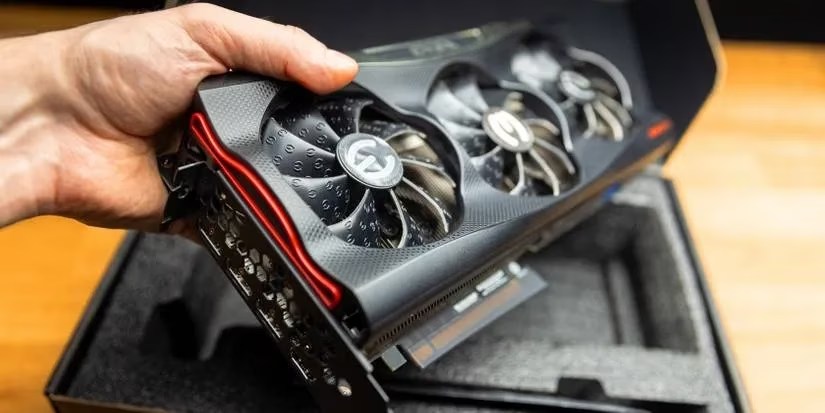
This wasn’t simply a mechanical supply crunch—it was a strategic pivot with a delayed fuse. The Hardware Times, quoting Chinese sources, had framed the move as a response to \u201cstrong demand from gaming notebook manufacturers,\u201d and indeed, the laptop segment was booming. Yet to desktop gamers, the decision felt like rain clouds gathering over a long-awaited picnic. Just when affordability seemed within reach after the crypto-fueled insanity of 2020\u20132022, NVIDIA’s production cut threatened to reverse the trend. By late 2024, the price of a mid-range GPU floated a staggering 40% above MSRP, a figure that would have been unthinkable during the glut years that followed the Ethereum Merge. The Merge itself—that September 2022 protocol shift that ended proof-of-work mining on Ethereum—had been a pressure valve. It removed the industrial-scale GPU hoarding that once turned living rooms into makeshift mining farms. Without that insatiable demand, supply chains had begun to heal. But NVIDIA’s sudden withdrawal of desktop chip allocation was like a surgeon reopening a wound that had only half-closed.
The story, however, never plays out as a monologue. While NVIDIA tightened its fist, AMD’s hand was already moving toward the chessboard. The launch of the Radeon RX 7700 XT and RX 7800 XT in the fall of 2024 injected a much-needed dose of competition, acting like a defibrillator on a flatlining consumer GPU market. Priced aggressively, the 7800 XT undercut the RTX 4080 by nearly $500, and its performance—while not trophy-winning—was good enough to sway builders who felt betrayed by NVIDIA’s price hikes. TechRadar had already noted dwindling supplies of the ultra-high-end RTX 4080 and 4090, which only amplified the sense of a market splitting in two: the elite tier becoming scarcer and more expensive, while AMD’s mid-range offerings carved out a sanctuary for the sensible buyer. Alex remembered watching the launch live, the chat scrolling with a strange mixture of hope and skepticism. It felt like two mountains leaning toward each other, their near collision somehow holding the valley steady.
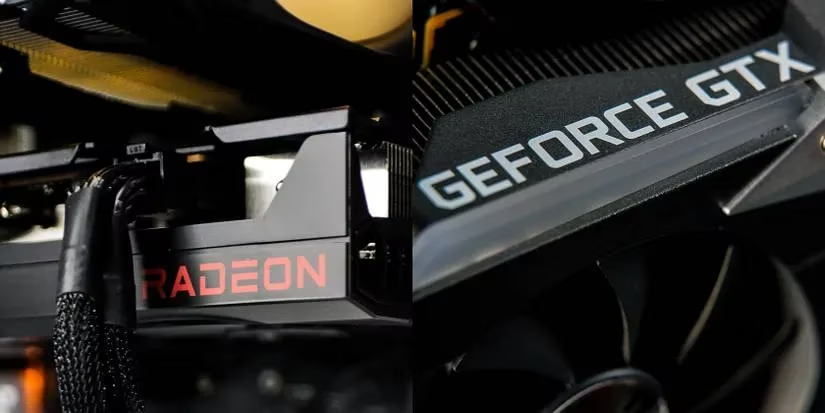
Looking back from 2026, the NVIDIA production cut had been neither catastrophe nor footnote—it was a pivot that reshaped expectations. Prices never returned to the easy-going levels of 2023, but they also didn’t spiral into the stratosphere. The constant jockeying between Team Green and Team Red kept the ceiling from breaking. Digital Trends reported that even at their most inflated in early 2025, NVIDIA 40-series cards averaged only 15% higher than their pre-cut levels, while AMD’s aggressive pricing forced occasional promotional dips. The real lesson, though, was how interconnected the market had become. A rumor about notebook demand in Taiwan could send shockwaves through a Best Buy in Ohio. A crash in Ethereum’s hash rate could, months later, loosen inventory just enough for a student to afford an upgrade. For Alex, who finally bit the bullet in January 2026 and bought an RX 7800 XT at 5% below MSRP, the ordeal had been an education in patience. The GPU market, he realized, was less a financial market and more a living ecosystem—one where a butterfly flapping its wings in a Santa Clara boardroom could trigger a hurricane in a gamer’s wallet. And as he watched his new card chew through Cyberpunk 2077 at 1440p ultra, he knew the wait had been worth it, if only because he had learned to read the winds before they became a storm.