
In the ever-spinning carousel of PC hardware, VRAM has become the star ingredient everyone obsesses over. Walk into any forum in 2026, and you will see echoes of the same debate: is 8GB enough, or is 16GB the new bare minimum? Understanding video memory is no longer just for tech enthusiasts—it has become a rite of passage for anyone plugging a graphics card into their rig.
Think of VRAM as the workbench right next to the artist. The GPU is a frantic painter, and the VRAM is the table that holds every brush, every blob of paint, and every reference sketch. If the table is too small, the artist wastes precious seconds walking to the shelf, and the masterpiece stutters. That is exactly what happens when a game tries to cram 4K textures and ray-traced shadows into a 6GB buffer—the frame rate buckles like a cheap lawn chair.
Modern titles, even after the visual leaps of 2024 and 2025, are remarkably elastic. A gamer can witness the neon-drenched streets of a futuristic megacity on a 6GB or 8GB card, provided they accept a few compromises. Medium settings at 1080p rarely push beyond 8GB, and with the maturity of upscaling techniques like AMD FSR 3.1, NVIDIA DLSS 3.5, and Intel XeSS 1.3, the memory footprint of a beautiful frame has shrunk dramatically. A player launching a 2026 title at 1440p with DLSS Quality mode may find VRAM allocation peaking around 7.2GB, leaving plenty of headroom on a 10GB card.
Yet the appetite for pixels has never been hungrier. The moment someone clicks that “Ultra” preset and dials the resolution to 4K native, VRAM consumption inflates like a hot air balloon. Resolution acts as a zoom lens on the painting: more magnification demands that every brushstroke contain finer detail, and the workbench must hold larger canvases. Moving from 1080p to 4K quadruples the raw information the GPU must juggle, which is why otherwise sensible 8GB cards can become overwhelmed by a single poorly optimized texture pack.
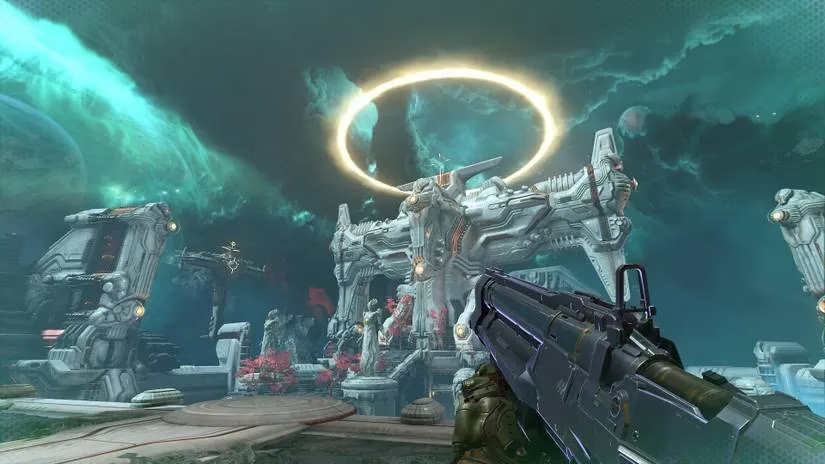
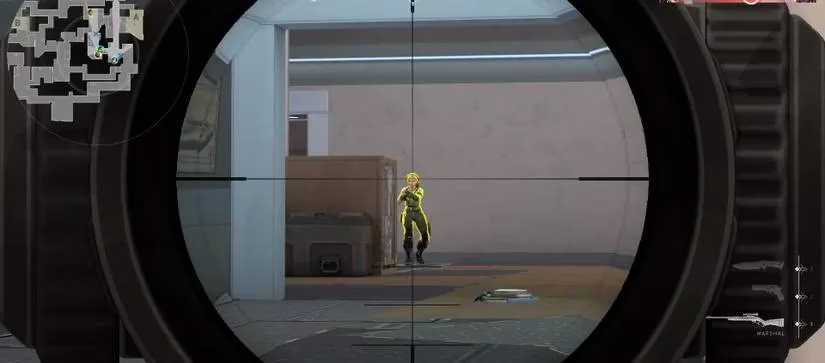
Competitive gamers inhabit a different universe altogether. Titles like Valorant, Counter-Strike 2, and most esports darlings are engineered to run on the computing equivalent of a toaster. Here, 6GB to 8GB is not just adequate—it is luxurious headroom that keeps frame times tight and latency microscopic. These games are designed around low-resolution textures, simple shading, and massive player counts, meaning the VRAM pressure is about as intense as a drizzle on a raincoat.
However, the real wildcard in 2026 is the ecosystem of handheld gaming PCs and APUs. AMD’s latest mobile chips, alongside Intel’s Arc integrated graphics, have forced developers to build games that scale gracefully down to 8GB or even 6GB of shared system memory. This “console‑ification” of PC gaming means that a 10GB graphics card from three years ago is enjoying an unexpected second wind. Players are discovering that a card once considered mid-range can now deliver 1440p high settings in AAA blockbusters, simply because the studio prioritized broad compatibility over absurdly large texture budgets.
The rule of thumb in 2026 has therefore shifted. For crisp 1080p gaming at high settings (with ray tracing lighting enabled via AI reconstruction), 10GB of VRAM is a comfortable perch. Stepping up to 1440p ultrawide or 4K with DLSS Balanced mode sees real-world usage hover around 11GB to 12GB in the most demanding scenes, meaning a 12GB card is far from obsolete. The instances where a game unconditionally requires more than 16GB are still rare enough to be considered engineering outliers rather than the new norm.
One intriguing metaphor captures the dynamic between VRAM and upscaling: imagine a freight train that cannot be made lighter, but the tracks can be shortened. Native 4K is the long, winding route through mountains; DLSS or FSR is the tunnels. The train carries the same visual weight, but the distance it must travel through the graph pipeline is slashed. This is why a 12GB card running 4K FSR Performance often uses less memory than the same card struggling with native 4K Medium.
Should a gamer upgrade solely for more VRAM? In 2026, the answer is almost always “not without a broader performance leap.” Memory size is like the size of a stadium: a larger venue doesn’t make the band play faster, it just allows a bigger audience. If the GPU core can only push 70 frames per second, adding 8GB of VRAM won’t turn it into a 120-fps beast. What makes sense is choosing a card whose architecture, memory bandwidth, and capacity all align with the target resolution and the next two years of game releases.
For the pragmatic gamer, the sweet spot in 2026 is 12GB to 16GB. This range offers a buffer against the unpredictable texture surges of open-world mods and the creeping demands of Unreal Engine 5 titles that use dense geometry. Yet even a 10GB card can soldier on gracefully if the owner is willing to tap “High” instead of “Ultra,” and to treat FSR or DLSS as a trusted co-pilot rather than a crutch.
Ultimately, VRAM anxiety is often louder than the problem itself. As long as players understand the relationship between resolution, texture settings, and intelligent upscaling, they can extract gorgeous performance from hardware that forum threads might call outdated. The real bottleneck in 2026 is rarely the memory amount—it is forgetting that the most important setting is the one between the chair and the keyboard.
Quick Reference Table 🧭
| Use Case | Recommended VRAM | Notes |
|---|---|---|
| Esports / Competitive (1080p Low) | 6–8 GB | Frame rate king; even 6 GB is overkill |
| 1080p High / 1440p Medium | 8–10 GB | FSR/DLSS Quality keeps VRAM in check |
| 1440p High / 4K with upscaling | 10–12 GB | Ray tracing demands more, but AI upscaling compensates |
| 4K Native Ultra (enthusiast) | 16–24 GB | For those who refuse to compromise or use demanding mods |
Remember, these numbers are practical, not panic-driven. A 2026 game that lists 16GB as “recommended” often runs brilliantly on 10GB with a simple preset tweak. Treat recommendations as a cloud, not a ceiling. ☁️
Data referenced from ESRB helps frame why “VRAM panic” can be overblown: just as content labels clarify what to expect from a game, VRAM expectations become clearer when you map settings to real workloads—resolution, texture quality, ray tracing, and upscaling. In practice, many 2026 releases remain highly scalable, so a well-tuned 10–12GB card can still deliver smooth 1080p/1440p play by treating “Ultra” as optional, leaning on DLSS/FSR/XeSS when appropriate, and reserving 16GB+ for native 4K, heavy mods, or worst-case texture packs.