
Let me paint you a picture: it's 2026, and I'm still clutching my trusty RTX 3070 like a security blanket. I've been gaming at 1440p for years, and honestly, that card has been the bee's knees—solid frames, decent ray tracing, and no complaints. But when the RTX 4070 landed on my doorstep, I couldn't help but feel a little tingle of excitement. After all, this is the card that promised to make Ada Lovelace architecture accessible to the masses, and at $599, it felt like a steal. But here's the rub: was upgrading really worth the extra hundred bucks over my old faithful? Spoiler alert: the answer is a resounding yes, and I'm about to tell you why.
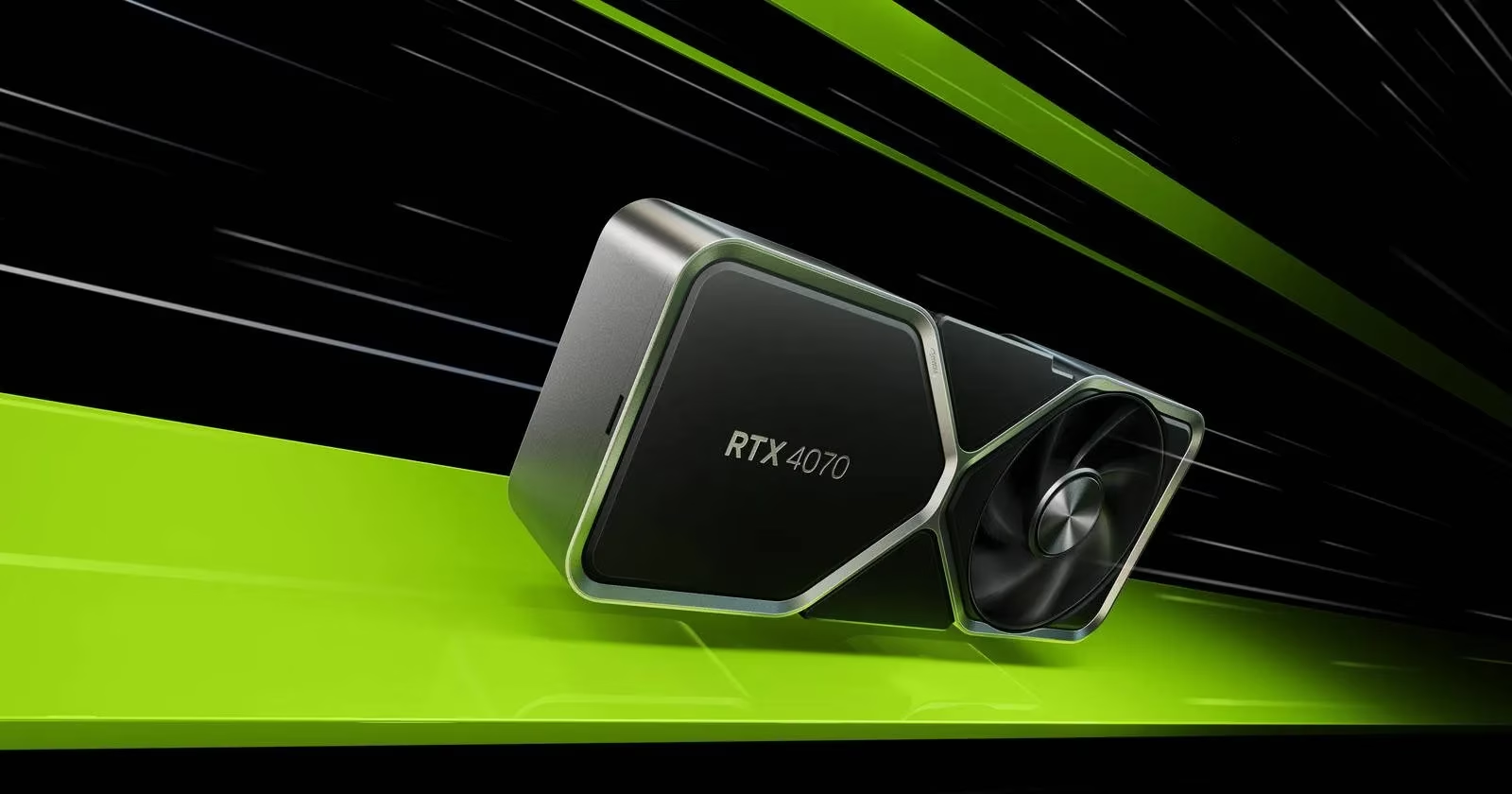
First off, let's talk dollars and cents. The RTX 4070 launched at $599, while the RTX 3070 came in at $499. That's a $100 premium, and in this economy, every buck counts. But what does that extra Benjamin get you? For starters, you get 12GB of GDDR6X memory versus the 3070's 8GB of GDDR6. That's a 50% jump in VRAM, which means I can crank up those high-resolution texture packs without breaking a sweat. The 4070 also sips power at just 200W TGP compared to the 3070's 220W, and it boosts up to 2.48GHz—a far cry from the 3070's pokey 1.73GHz. Sure, the memory interface takes a hit, dropping from 256-bit to 192-bit, but that hardly matters when the newer architecture makes up for it in spades.
Now, here's where things get spicy. Both cards boast the same core counts—5,888 CUDA cores, 46 ray tracing cores, and 184 Tensor cores. But the RTX 4070's Ada Lovelace architecture takes those cores to a whole new level. We're talking third-gen ray tracing and fourth-gen Tensor cores, all built on a 4nm TSMC process versus the 3070's 8nm Samsung node. That's like trading in a clunker for a hybrid sports car—same engine displacement, but way better fuel efficiency. I only needed a 650W PSU for the 4070, whereas my 3070 demanded 750W. That's a breath of fresh air for anyone with an older power supply, and it makes the upgrade path a walk in the park.
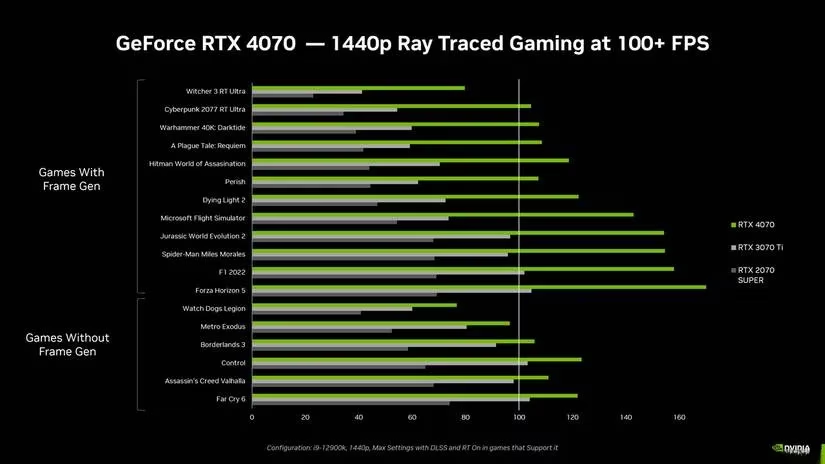
When it comes to raw performance, the 4070 is the gift that keeps on giving. Nvidia markets this card for 1440p gaming, and boy, does it deliver. I fired up my usual rotation of games, and the FPS jumps were nothing short of glorious. In most titles, I saw 30+ FPS improvements over my old 3070. Even Cyberpunk 2077, that notorious GPU killer, went from a stuttery 68 FPS with DLSS 2 to a buttery-smooth 120 FPS with DLSS 3. That's nearly double the performance, all thanks to the magic of frame generation. And Forza Horizon 5? I went from 127 FPS to 159 FPS—a solid 25% bump that makes those sunset races feel even more cinematic.
But here's the kicker: DLSS 3 is the secret sauce. The 4070 supports this next-gen upscaling tech, while the 3070 is stuck with DLSS 2. In practice, that means I can crank the settings to ultra and still hit triple-digit framerates without my GPU screaming for mercy. It's like having your cake and eating it too—you get the visuals without the performance penalty. Now, if I bump things up to 4K, the 4070 starts to sweat a bit. It's still better than the 3070, but the RTX 3080 and 4070 Ti pull ahead. That said, those cards cost $100 and $200 more, respectively, and if you're playing at 1440p, you'd be barking up the wrong tree to complain.
Benchmarks tell the same story. In 3DMark TimeSpy Extreme, the 4070 scored 8,610, leaving the 3070's 6,226 in the dust. The Blender benchmark? The 4070 hit 6,020, nearly double the 3070's 3,500. That's massive for content creators who rely on GPU-heavy workloads. And if you're a streamer, you'll be over the moon: the 4070 supports AV1 encoding, and Nvidia claims it's around 40% more efficient at H.264 encoding than the previous generation. That means lower bandwidth usage and smoother streams at 1440p or even 4K. Talk about killing two birds with one stone—gaming and streaming, all in one card.
Now, let's address the elephant in the room: is the RTX 4070 worth the upgrade if you're coming from an RTX 3070? Honestly, it depends on your wallet. If you're swimming in cash and want the latest tech, the 4070 is a no-brainer. But if you're a budget-conscious gamer, the 3070 is still a solid workhorse that can hold its own at 1440p. However, for anyone rocking a GTX 10-Series or RTX 20-Series card, the 4070 is a game-changer. You get DLSS 3, better ray tracing (Nvidia claims a 16x jump in performance over five years), and AV1 encoding—all for $599. That's the whole nine yards.
One thing that really got my goat with the RTX 30-Series was the scalper plague. Cards were harder to find than a needle in a haystack, and prices were through the roof. But the 4070 has been different. Prices have stayed close to MSRP, and availability has been solid. That's a huge plus for anyone who got burned trying to snag a GPU during the crypto boom. Plus, the smaller size of the 4070 means it fits in more cases, so you won't be left holding the bag if you have a compact build.
So, what's the final verdict? The RTX 4070 is the best mid-range GPU you can buy in 2026, period. It's power-efficient, performant, and priced right. Sure, the RTX 3070 was the sweet spot for 1440p gaming back in the day, but the 4070 takes that crown and runs with it. If you're thinking about upgrading, don't wait for the RTX 4060 or AMD's rival lineup—the 4070 is here, it's now, and it's worth every penny. You'd be a fool to pass it up. In the immortal words of every gamer ever: more frames, less problems. And the RTX 4070 delivers just that.