
Watching the steady cadence of Apple's creations unfold is akin to observing a meticulously choreographed dance. The MacBook, in particular, moves through its existence with a distinct tempo, shaped by unseen market currents and the silent hum of technological progress. Its journey, while seemingly predictable, carries the subtle irregularities of a living organism responding to its environment. This rhythm, this life, finds structure in the framework known as the Product Life Cycle—a conceptual map charting the voyage from bright dawn to quiet twilight. For the MacBook, this cycle reveals not just a timeline, but a narrative of adaptation and resilience, a story less frantic than its pocket-sized sibling, the iPhone, yet equally compelling in its measured grace.
 Visualizing the Ebb and Flow: The Product Life Cycle Curve
🌱 The Dawn: Introduction
A whisper becomes a presence. This initial stage is a delicate unveiling, where awareness is carefully cultivated. Marketing paints possibilities, highlighting advantages that shimmer like promises. The new MacBook model steps onto the stage, bathed in the spotlight of anticipation. Production is measured, cautious. Will the audience embrace it? The air crackles with potential, yet the path forward remains unwritten. This is the moment of conception, where the product's identity begins to form in the collective consciousness.
📈 The Ascent: Growth
When acceptance blooms, demand surges. The quiet hum intensifies into a roar. Production lines quicken their pace, feeding the growing appetite. The MacBook finds its footing, its value proposition resonating. Sales climb, validating its place. This phase is characterized by energy, expansion, the satisfying pull of a product finding its tribe. It’s the springtime of the cycle, vibrant and full of upward momentum. The device is no longer a novelty; it becomes a contender.
🏛️ The Plateau: Maturity
Here, the MacBook reaches its zenith. Sales stabilize, often at their highest volume. The frantic energy of growth mellows into a confident stride. Production costs often decrease, marketing shifts from introduction to reinforcement. Efficiency reigns. For the MacBook Pro, this stage has proven remarkably enduring—a testament to its design and acceptance. It becomes the 'go-to', the reliable standard. 💻 Redesigns occur here, subtle evolutions rather than revolutions, refreshing the form without abandoning the proven core. This plateau isn't stagnation; it's mastery of the current landscape.
| Feature | Growth Stage | Maturity Stage |
|---|---|---|
| Focus | Demand & Production Scale | Sales Optimization |
| Marketing | Building Awareness | Reinforcing Value |
| Competition | Emerging | Intensifying |
| Product | Rapid Adoption | Refined Iterations |
📉 The Descent: Decline
Change is the only constant. Competitors emerge with compelling alternatives. Technology leaps forward, casting shadows on older capabilities. Consumer interest, ever fickle, begins to wane. Sales dip. The once-dominant MacBook model finds itself gently, inevitably, ushered towards the exit. Apple's own relentless innovation accelerates this transition; newer, brighter stars rise, hastening the older model's journey into obsolescence. This phase is a quiet sunset, a gradual dimming.
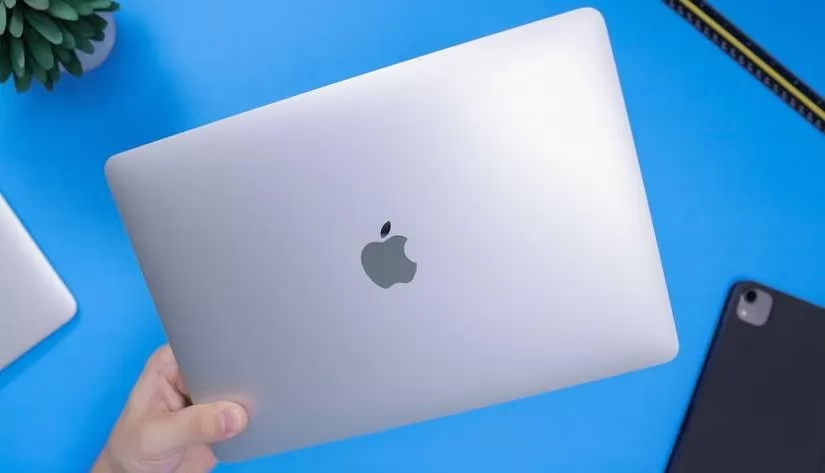 Contrasting Paths: MacBook Stability vs. Other Tech Volatility
⚖️ The MacBook Anomaly
While the Product Life Cycle provides a lens, the MacBook narrative bends the framework. Its average cycle hums around 3.5 years, punctuated by new iterations every 1.5 years. Yet, distinct models are fewer, a deliberate choice preventing internal cannibalization. The MacBook Pro, especially, defies the typical rapid decline:
-
Extended Maturity: Consistent sales volume acts as an anchor, prolonging its prime.
-
Minimal Marketing Overhead: Its established reputation reduces the need for costly awareness campaigns.
-
Strategic Redesigns: Evolution within the generation, not constant revolution, sustains relevance.
Unlike the iPhone, a whirlwind of rapid-fire iterations driven by miniaturized tech and fierce competition, the MacBook moves with a different cadence. It is the deep-rooted oak compared to the seasonal blossom. Market forces, user demand, and technological tides still sway it, but the oscillations feel less violent, more integrated into its core purpose as a robust, functional tool. Apple’s prescience—their ability to track the hidden currents of the tech world—allows them to navigate this cycle with a conductor’s precision, ensuring the MacBook’s maturity isn’t complacency but a confident holding of ground.
⏳ Beyond the Cycle
This framework illuminates patterns, yet the full picture remains elusive. Forces driving change are often hidden, sudden, or complex. Planned obsolescence whispers in the background. Unexpected breakthroughs can reset the clock. The MacBook’s journey, while beautifully mapped by the cycle’s four stages, is ultimately a story written by a confluence of factors only partially visible. Its rhythm is steady, yes, but never entirely predictable. The pulse continues, a testament to Apple's constant innovation and the MacBook's enduring place as a functional cornerstone, less tossed by the whims of the cycle than many, yet forever subject to time's inexorable flow.
And so, the dance continues. From the hushed anticipation of introduction, through the vibrant surge of growth, across the broad plateau of maturity, and finally, the gentle descent—the MacBook lives its cycle. It is a rhythm less frantic than the smartphone's staccato beat, a deeper, more resonant pulse echoing the enduring value of a tool designed not just for the moment, but for the work yet to come. Its story, framed by the cycle, is ultimately one of measured adaptation, a quiet testament to finding stability amidst the relentless current of technological change.