
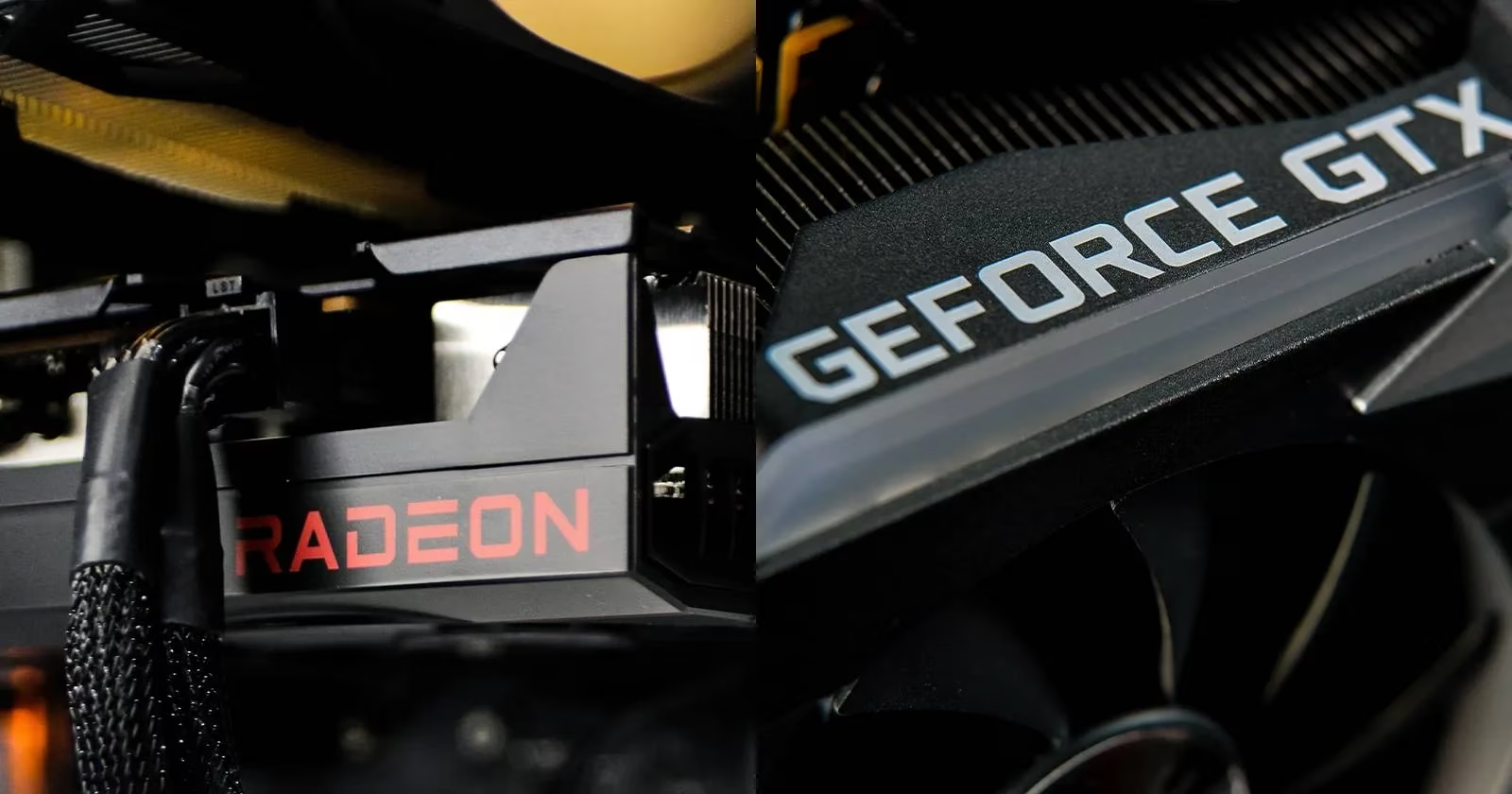
It’s a classic scene: you’re building a PC on the tightest possible budget, and the question isn’t about chasing 1440p ultra settings. It’s about finding anything that will let you actually play modern games without turning every session into a slideshow. In 2026, the idea of buying a brand‑new, ultra‑cheap graphics card might feel a little retro—but the used market is flooded with these very cards, and the same decision still pops up every single day. Two names keep appearing: the AMD Radeon RX 6400 and the NVIDIA GeForce GTX 1630. Both launched back in 2022, and time has only sharpened the differences between them.
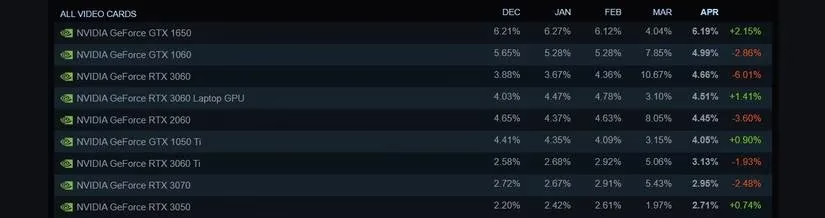
Even four years after their release, these two cards are exactly what many budget builders end up staring at. And here’s a funny thing—if you check the old Steam Hardware Survey from those days, the most popular GPUs were never the fire‑breathing monsters. They were the GTX 1650 and GTX 1060, the affordable champions of their generations. So, the real question hasn’t changed: what’s the smartest way to squeeze every last frame out of very little money? Let’s put the RX 6400 and the GTX 1630 under the microscope.
Specifications: A Clear Paper Advantage
On the surface, the two cards seem closely matched—both bring 4GB of VRAM and sip power. But dig a tiny bit deeper, and the RX 6400 struts in with some serious bragging rights. It’s built on a 6 nm process, while the GTX 1630 still hangs on to an older 12 nm node. That gives AMD’s underdog faster clock speeds, a more efficient memory interface, and even a basic level of hardware ray‑tracing support. Oh, and the RX 6400 pulls off all of this while drawing less power. Go figure.
| Specification | AMD Radeon RX 6400 | NVIDIA GeForce GTX 1630 |
|---|---|---|
| Architecture | RDNA 2.0 | Turing (TU117) |
| Process Node | 6 nm | 12 nm |
| Base Clock | 1923 MHz | 1740 MHz |
| Boost Clock | 2321 MHz | 1785 MHz |
| Memory | 4GB GDDR6 | 4GB GDDR6 |
| Memory Bandwidth | 128 GB/s | 96 GB/s |
| TDP | 53W | 75W |
| Ray Tracing | Yes (limited) | No |
The raw processing numbers just add more weight to the imbalance. When you look at theoretical compute power, the RX 6400 spits out roughly double the half‑precision and single‑precision performance of the GTX 1630. That’s not a small margin—it’s the RX 6400 casually strolling past the GTX 1630 while the latter is still tying its shoelaces.
Real‑World Performance: Frames Don’t Lie
Benchmarks run with a Ryzen 9 5950X and 32GB of RAM at 1080p tell a story that’s impossible to ignore. Across a handful of popular titles, the RX 6400 consistently delivered frame rates that hovered in the 60 FPS range or close to it with sensible settings. The GTX 1630? Let’s just say it had a rough time. Average FPS of around 38 might sound technically playable, but the 1% lows often dipped to 30 FPS or below—resulting in choppy, stutter‑filled gameplay that makes you want to pull your hair out. For the RX 6400, 1% lows stayed healthier, keeping the experience smoother even when things got hectic on screen.
You might be thinking, “Well, these are cheap cards, so what did you expect?” Fair point. But here’s the kicker: the RX 6400 easily tripled the frame rate in some lighter esports titles compared to the GTX 1630. That’s the difference between a card that can genuinely serve as a daily driver for an undemanding gamer and one that feels outdated the moment you plug it in.
Price and Value: Paying Less for More
At launch, the RX 6400 was priced at $159, while the GTX 1630 asked for $169—$10 more for noticeably worse performance. As months went by, prices on both cards dipped, but the value gap only widened. Even today, picking up a used RX 6400 typically costs less than a used GTX 1630. When you calculate the price‑per‑frame, the RX 6400 works out to something like $2.50 per average FPS in a mixed‑game workload; the GTX 1630 clocks in at over $4. That’s a pretty steep tax for weaker hardware.
It’s one of those rare situations where you actually pay less and get more. The GTX 1630 ended up in a weird no‑man’s land—too expensive to be a throwaway purchase, yet too slow to justify its existence against even integrated graphics on newer CPUs.
A Better Path: Look Slightly Higher
Now, here’s where the story takes a turn. If you’re already shopping at the $150 mark, why not move up just a single rung on the GPU ladder? The RX 6500 XT can regularly be found for around the same price on the used market, and it outperforms both of today’s contenders by a comfortable margin. Similarly, a used GTX 1650—while still not amazing—can be a noticeable step up. But honestly, even a second‑hand RTX 2060 sometimes appears at not much more money, and that card unlocks proper ray tracing and DLSS support.
There’s also a quiet warning here: if you go with the GTX 1630, you’re essentially locking yourself into older titles or games with extremely low requirements. The RX 6400, at least, gives you a fighting chance in newer releases—even if you have to tweak settings to medium or low. But neither card will satisfy you for long if you have even a slight itch for modern AAA gaming.
The Real Takeaway in 2026
By now, these two GPUs have become fixtures of entry‑level used builds, and the verdict remains solid. If you’re down to your last dollar and absolutely need a dedicated video card today, the RX 6400 is the one to grab. It’s cheaper on the wallet, far kinder in terms of performance, and doesn’t leave you staring at a slideshow when things get busy on screen.
But—and this is a big but—the smartest move is almost always to save up just a tiny bit more or explore the used market for a card one tier higher. A PC that struggles to break 30 FPS in basic games is a one‑way ticket to frustration. You’ll end up tossing aside that budget card months later, spending more cash to fix a problem you could have avoided from the start. Sometimes, the most affordable option isn't the cheapest one on the price tag—it's the one that keeps you happily gaming without an upgrade loop hanging over your head.